The executive office is one of the most considered spaces in any NYC firm. It needs to perform on multiple levels at once. It is a workspace, a meeting room, a statement of professional standing, and in many cases the setting where clients form their first impression of the business. Getting it right takes more than choosing an expensive desk and a good chair. It requires thinking through every element of the space, from the furniture configuration to the materials to the way natural light moves through the room during the day.
At Benhar, we have been designing and furnishing executive offices for NYC's law firms, financial institutions, and corporate headquarters for over two decades. What follows is an honest guide to what the best executive offices in the city look like in 2026, what has changed, and what to prioritize when you are specifying one.
What Has Changed in Executive Office Design
The executive office of 2026 looks different from what it did ten years ago, and the shift is not just aesthetic. Three things have changed the brief in meaningful ways.
The return to craft and materiality
After a decade of minimalism driven by open plan culture and tech-company aesthetics, we are seeing a clear return to material richness in executive spaces. Wood veneer, leather, stone, and brass are back. Not in the heavy, traditional sense of mahogany paneling and red carpet, but in a more considered, contemporary way. The best executive offices in NYC right now combine warm natural materials with clean lines and restrained detailing. The result feels substantial without feeling dated.
Technology integration as a baseline expectation
Five years ago, a well-integrated executive office might have had a single screen and a docking station. Today, a C-suite office without seamless video conferencing capability, a dedicated display for presentations, and clean cable management is considered underspecified. The technology brief has expanded significantly, and it shapes the furniture choices. Desks need to accommodate more cables, more peripherals, and more power access than ever before. This is not optional, it is the expectation.
The in-office meeting space
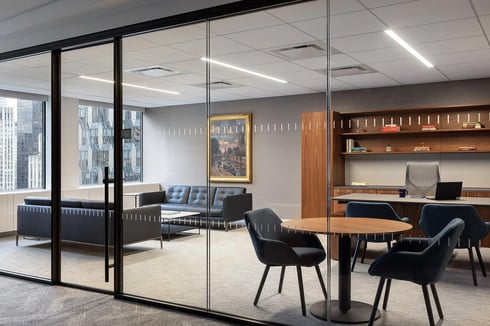
The shift to hybrid working has changed what executive offices are used for. Partners and C-suite leaders who are in the office fewer days per week use those days more intensively for in-person meetings. The secondary seating area within the executive office, traditionally a pair of visitor chairs in front of the desk, has grown in importance. The best executive offices now have a genuine small meeting area, a table and three or four chairs, or a lounge pair and a low table, that allows for proper in-office conversations without requiring a separate room booking.
The Executive Desk: Where to Start
The desk is the anchor of any executive office. It sets the scale, establishes the material palette, and defines the working configuration of everything around it. Getting this choice right makes every other decision easier.
Size and configuration
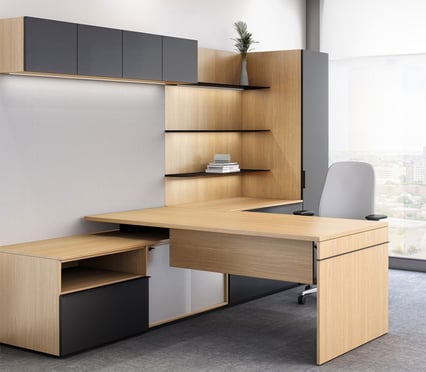
Executive desks in NYC offices typically run between 66 and 84 inches in length and 30 to 36 inches in depth. A deeper desk at 36 inches gives more working surface and better visual presence. For C-suite roles involving a lot of document review or dual-screen working, a return or credenza extension adds meaningful usable surface without making the room feel cramped. The L-shaped or U-shaped configuration remains the most practical for senior roles. It creates a clear separation between the primary work surface, typically facing the room, and a secondary surface for reference materials, a second screen, or meetings with one or two people without moving from the desk.
Materials
The most requested executive desk finishes we are specifying right now in NYC fall into three categories.
- Wood veneer: walnut, oak, and white oak are all strong right now. Walnut in particular has become the prestige wood of choice in Manhattan's top law and finance offices. It reads warm, serious, and contemporary without feeling traditional. Book-matched veneer on the desk face adds a level of craft that clients and visitors notice.
- Lacquered finishes: a high-gloss or satin lacquer in a neutral or near-neutral tone, warm whites, deep charcoals, and soft greiges, is a popular choice for more contemporary executive environments. It photographs well, ages well with proper care, and pairs cleanly with almost any other material in the room.
- Stone or glass surfaces: a stone or glass desktop insert, used as a working surface on top of a veneer or lacquered base, is a feature we are seeing more of in high-end executive fitouts. It adds visual weight and a sense of permanence that a veneer surface alone cannot replicate.
Storage
Executive desks should include integrated pedestal storage, either a fixed or mobile two or three drawer unit, for the practical reality of daily working. What we caution against is over-specifying storage in the desk itself at the expense of the credenza, which is where the bulk of filing and equipment should live. A desk that is visually cluttered with storage units loses the clean proportions that make an executive office feel right.
Executive Seating: The Chair Matters More Than You Think
The executive chair is not simply a status symbol. It is the piece of furniture the occupant spends the most time in, and its performance directly affects how the person feels and works throughout the day. In our experience, this is the one area where cutting costs consistently produces regret.
Herman Miller Aeron (executive specification)
The Aeron remains the most widely specified task chair in NYC executive offices, and for good reason. In its fully specified configuration, with polished aluminum base, lumbar support system, and premium arm options, it reads as the considered professional choice without calling attention to itself. The 12-year warranty and Benhar's local service relationship mean that any issues are resolved quickly. For law and finance environments where the chair is used intensively for long sessions, nothing else in this price range comes close on ergonomic performance.
Herman Miller Embody
The Embody is increasingly the chair of choice for C-suite roles in NYC's tech, media, and creative sectors. Its distinctive back profile and broader silhouette make it a stronger design statement than the Aeron, and its focus on cognitive performance suits roles that involve sustained, complex decision-making over long sessions. Available in a wide range of premium fabrics and finishes that suit the elevated material palette of a well-designed executive office.
Knoll Saarinen Executive Chair
For the most client-facing and design-sensitive executive environments, the Knoll Saarinen Executive Chair is difficult to match. Its iconic tulip form, premium upholstery options in leather and high-performance fabrics, and undeniable visual presence make it a natural fit for the corner office in a prestige firm. We specify it most often in law firm partner offices and financial services executive suites where the aesthetic brief is as important as the ergonomic one.
A note from our team: we always recommend a seating trial before an executive chair order. What works for one person's posture and working style does not always work for another. Our team can arrange sample chairs from our certified MillerKnoll stock so the occupant can evaluate before committing.
The Secondary Seating Area
As noted above, the secondary seating area within the executive office has grown in importance in the hybrid working era. The right specification depends on how much in-office meeting the role involves and how formal those meetings tend to be.
The lounge pair
Two good lounge chairs and a low table or ottoman is the most versatile option. It creates a space that reads as relaxed and accessible, which works well for partners and leaders who want in-office conversations to feel less formal than a boardroom. The chairs should be properly upholstered with a solid frame. The Knoll Saarinen Womb Chair, the Florence Knoll Lounge, and the Herman Miller Eames Lounge are all pieces we specify regularly in this context.
The small meeting table
For roles that involve more structured in-office meetings with two or three people, a small meeting table with three or four chairs is the stronger option. A 42 to 48 inch round table works well in most executive office footprints without overwhelming the space. It provides a proper working surface and signals that the room is set up for professional discussion. The Knoll Saarinen table in a smaller diameter is a natural choice in executive environments where the rest of the furniture already carries design intent.
The Credenza: Functional and Foundational
The credenza is the most underrated piece of furniture in the executive office. It provides the storage that keeps the desk clear, the surface that supports AV equipment and display pieces, and the visual weight that anchors the wall behind the desk. A well-chosen credenza ties the room together in a way that nothing else does.
In terms of specification, the credenza should be sized to run the majority of the wall it sits against, typically 72 to 96 inches in length for a standard executive office. The material should match or complement the desk finish. And it should be built to a quality that matches the rest of the room. We see too many executive offices where the desk is excellent and the credenza is an afterthought, and it shows.
- Specify the credenza at the same time as the desk, from the same manufacturer or at least the same material family
- Allow for equipment storage, AV routing, and power access in the credenza specification
- Consider a display panel or artwork above the credenza as the visual focal point of the room
- If the credenza includes open shelving, style it intentionally — an unstyled open shelf in a senior office looks unfinished
Materials, Finishes, and the Details That Elevate a Room
The difference between a good executive office and a great one is almost always in the details.
Flooring
A quality area rug under the seating area is one of the most effective things you can do for an executive office. It defines the meeting zone, adds acoustic warmth, and signals that the space has been designed rather than merely furnished. In buildings with hard flooring, the rug is not optional if the room is to feel right.
Lighting
Overhead lighting alone is insufficient in an executive office. A combination of task lighting at the desk, ambient lighting from a floor or table lamp in the seating area, and controlled natural light creates the layered effect that makes a room feel considered rather than functional. Dimmer controls allow the light level to be adjusted for different uses of the space throughout the day.
Wall treatment
Painted walls are the baseline. A step up is a feature wall in a complementary material, paneling, a large-format stone effect, or a bespoke fabric panel, that adds depth and visual interest without requiring an architectural intervention. We work with clients on wall treatment as part of the furniture specification process, because the two need to be considered together.
Window treatment
In NYC office buildings where executive floors often have significant glazing, window treatment is a practical necessity for glare control and an aesthetic opportunity. Motorized roller blinds in a quality fabric, or sheer curtains with a blackout option, are the most common specifications. The choice should be made in the context of the overall material palette of the room.
Technology
The technology specification for a 2026 NYC executive office should include at minimum a primary display at 55 to 65 inches for presentations and video calls, a dedicated video conferencing camera positioned at eye level, directional microphone capability, a clean docking solution that allows the occupant to connect with a single cable, and concealed cable management throughout. The technology should be invisible when not in use and effortless when it is.
What NYC's Top Industries Are Specifying Right Now
Partner offices in NYC law firms remain among the most considered executive spaces in the city. The brief is consistently for warmth, permanence, and professional gravitas. Walnut veneer desks, leather upholstery, framed artwork, and quality area rugs are all standard. The Aeron or Saarinen Executive Chair is almost universal. Credenzas with concealed filing are a priority given the document-heavy nature of legal work. Technology integration has increased significantly but should be invisible in a well-specified law firm partner office.
C-suite offices in financial institutions tend to lean toward a cleaner, more contemporary aesthetic than law firms, though the quality expectations are the same. Lighter veneer finishes, stone or glass surface inserts, and a more restrained material palette are all common. Technology integration is typically more prominent, with dual-screen setups and dedicated video conferencing equipment the norm. The Aeron or Embody tends to be the task chair of choice.
Executive offices in NYC tech and media companies have a different brief altogether. The aesthetic is typically less formal and more personality-driven, reflecting the culture of the business. Statement furniture pieces, more experimental material choices, and a less hierarchical seating arrangement are all common. The Embody or Cosm is frequently specified as the task chair, and the secondary seating area often leans toward lounge rather than formal meeting. That said, quality expectations are high — executive spaces in this sector still need to make a strong impression.
Frequently Asked Questions
How much does executive office furniture cost in NYC?
A well-specified executive office with a quality desk, task chair, credenza, and secondary seating area typically runs between $25,000 and $75,000 in total furniture investment depending on the brands, materials, and level of customization. C-suite offices with bespoke millwork, premium upholstery, and full technology integration can exceed $100,000. We are happy to provide a project-specific estimate based on your brief.
What is the best executive desk for a NYC law firm partner office?
For law firm partner offices, we most frequently specify walnut veneer desks with integrated pedestal storage and a matching credenza. The Knoll Reff Profiles system and custom millwork from our manufacturing partners are both strong options depending on the level of bespoke specification required. The desk should be sized generously, a minimum of 72 inches in length, to match the seniority of the occupant and the formality of the environment.
What is the best task chair for an executive office?
For most NYC executive environments, the Herman Miller Aeron in its fully specified configuration is the default choice. For roles involving intensive cognitive work, the Embody is worth considering. For the most design-sensitive environments, the Knoll Saarinen Executive Chair is a strong option. We recommend a trial before committing, particularly for chairs in this price range.
How do I integrate technology cleanly into an executive office?
Clean technology integration in an executive office requires planning at the furniture specification stage, not after. The key decisions are the display size and mounting method, the cable routing through the desk and credenza, the docking solution, and the video conferencing setup. We work with our clients' IT and AV teams during the specification process to ensure the furniture and technology are designed together rather than independently.
How long does executive office furniture take to deliver in NYC?
Standard configurations from our certified MillerKnoll stock typically deliver and install within seven to ten weeks. Custom desks, bespoke millwork, and fully specified executive packages with custom finishes generally run eight to twelve weeks. We recommend finalizing specifications at least twelve to sixteen weeks before your target completion date for a fully custom executive office.
Should an executive office have a private meeting area?
In most cases, yes. The shift to hybrid working has made the in-office meeting more valuable and more intentional. An executive who is in the office three days a week will use those days for the conversations that benefit most from being in person. Having a properly set up secondary seating area within the office means those conversations can happen without booking a conference room and without the disruption of moving to a different space. For senior client-facing roles in particular, this is worth prioritizing in the layout.
Designing an Executive Office in NYC?
We have been specifying and installing executive offices across New York City's top law firms, financial institutions, and corporate headquarters for over two decades. As a certified MillerKnoll dealer, we give you access to the full Herman Miller and Knoll range alongside our custom furniture and millwork capability. Our team handles everything from the initial space plan to white-glove installation. Get in touch with our team today to start the conversation.

.jpg?width=514&height=343&name=Benhar%20showroom%20photos%20(16).jpg)